 |
| CLICK HERE TO VIEW CURRENT ISSUE |
 |
| Best of NAMA 2026 |


|
 |
|
RABORESEARCH: CHALLENGING TIMES FOR HOG PRODUCERS WITH RISING COSTS, LOWER PRICES, DECREASING DEMAND
Oct. 29, 2021
Source: Rabobank news release
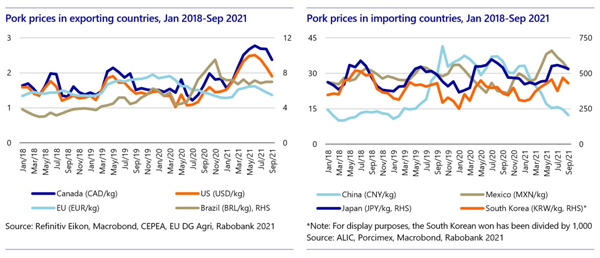
Global hog prices moved sharply lower, as the global recovery in production has outpaced the rebound in demand. Herd growth in 2022 is expected to slow due to the rapid decline in prices and resulting producer losses. Labor constraints in some markets and cost inflation will pressure production margins. The pass-through of these costs to consumers is likely to weigh on demand, further dampening consumption.
According to the latest pork report from Rabobank, global hog producers are facing a challenging outlook. Structural and transitional supply chain disruptions and tight global grain stocks are raising the cost of production, just as a growing hog supply is driving prices lower. "The most severe impact is being felt in markets that were slow to recover from the pandemic or have struggled with trade disruption or disease," explains Christine McCracken, Senior Analyst - Animal Protein at Rabobank.
Limited pricing power and higher costs are also pressuring hog production returns, resulting in scaled-back growth plans in many markets. This follows a strong year of pork production in 2021, with total year-over-year gains expected to be 3.4%. Tight global inventories of corn and soybeans, together with the recent surge in fertilizer and chemical costs, are expected to drive increased volatility in feed markets in 2022.
Expectations of higher costs for most producers are made worse by higher herd loss due to disease. "New cases of traditional health challenges like PRRS and PEDv drove larger-than-expected losses in 2021, but productivity should improve as the herd builds immunity. African swine fever (ASF) also remains an issue in many parts of the world, with active cases in China, the Philippines, South Korea, Vietnam, and Europe," says McCracken.
More recently, the virus has reappeared in a commercial herd in Russia and was discovered in the Americas, with new cases in the Dominican Republic and Haiti. These new cases, while not economically meaningful, create new risks for regional production. "ASF not only threatens the survivability of the herd, it also typically eliminates trade, which can be equally devastating," adds McCracken.
High-cost pork will face the greatest resistance at foodservice, as the industry is already struggling with higher labor and food costs. "Ultimately, consumers will likely trade down to lower-cost cuts and other proteins or will reduce pork consumption altogether. This slowdown in expected demand is likely to drive a wider imbalance with supply, ultimately slowing trade and driving prices lower," according to McCracken. However, larger pork volumes are still expected to be absorbed as the global market emerges from the pandemic, even as higher pork prices will limit consumption.
|
|
|
|
|