|
| CLICK HERE TO VIEW CURRENT ISSUE |
 |
| Best of NAMA 2026 |


|
 |
|
U OF ILLINOIS ISSUES UPDATED 2022 CROP BUDGETS
Dec. 9, 2021
Blog by Gary Schnitkey, Krista Swanson, and Nick Paulson, Department of Agricultural and Consumer Economics, University of Illinois and Carl Zulauf, Department of Agricultural, Environmental and Development Economics, Ohio State University
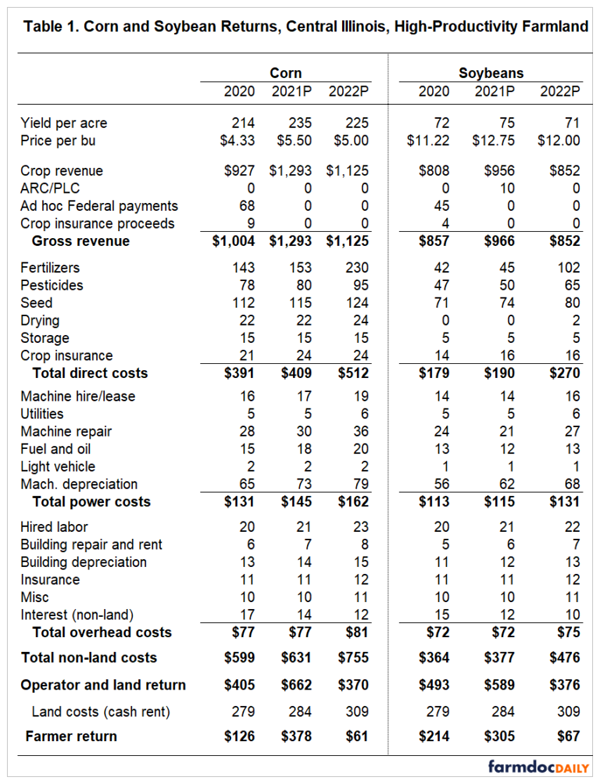
Illinois crop budgets for 2022 have been revised from their initial release in July (farmdoc daily, July 27, 2021). Significant changes from the initial release are increased corn prices, soybean prices, and non-land costs. The cost with the largest increase is fertilizer. Total costs will be at all-time highs in 2022. Still, we are projecting positive returns for 2022, given relatively high corn and soybean prices. Moreover, our return estimates do not suggest large changes in acres from 2021 to 2022.
Updated Budgets
Updated 2021 and 2022 projections are contained in two publications in the Management section of farmdoc. First, the 2022 Crop Budgets give corn-after-corn, corn-after-soybeans, soybeans-after-corn, soybeans-after-soybeans, and wheat budgets for four regions: northern Illinois, central Illinois with high-productivity farmland, central Illinois with low-productivity farmland, and southern Illinois. A double-crop soybeans budget also is given for all regions except northern Illinois.
The second publication - Revenue and Costs for Illinois Grain Crop - shows yearly returns and costs of producing corn, soybeans, wheat, and double-crop soybeans by region of Illinois. These budgets represent average returns no matter the preceding crop and are summarized from farms enrolled in Illinois Farm Business Farm Management (FBFM).
Table 1 shows corn and soybean performance for 2020, 2021, and 2022 on high-productivity farmland in central Illinois. Similar results for northern Illinois, central Illinois low-productivity farmland, and southern Illinois are available in the Revenue and Costs for Illinois Grain Crops publication. Trends in Table 1 for high-productivity farmland also occur across regions.
To view the complete report, click here.
|
|
|
|
|