|
 |
|
|
|||


|
 |
|

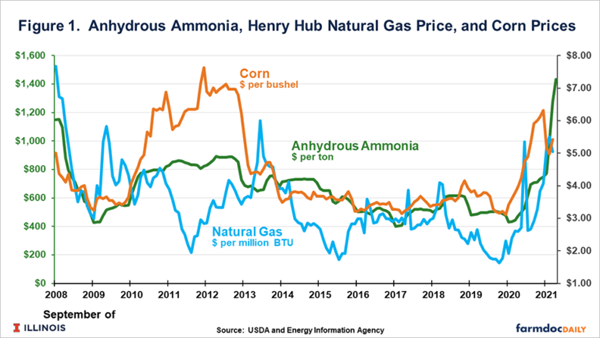
Dec. 16, 2021 Blog by Gary Schnitkey, Nick Paulson, Krista Swanson, and Jim Baltz, Department of Agricultural and Consumer Economics, University of Illinois and Carl Zulauf, Department of Agricultural, Environmental and Development Economics, Ohio State University Nitrogen fertilizer prices are positively related to corn and natural gas prices. Because of current high corn and natural gas prices, one would expect nitrogen prices also to be high. However, in recent months, anhydrous ammonia prices have exceeded levels one would expect, even given higher corn and natural gas prices. Supply disruptions caused by Hurricane Ida may help explain recent high prices, but other factors could also be in play. In any case, high nitrogen fertilizer prices are likely into the spring, which suggests that large reductions in nitrogen rates need to occur.
Nitrogen Prices Continue to Increase Since summer, nitrogen prices have risen dramatically, reaching record-high levels (see Figure 1). According to the most recent data from the Agricultural Marketing Service, nitrogen prices have continued to rise into December. On December 3rd, the average price in Illinois for anhydrous ammonia was $1,434 per ton, up by $91 per ton from the price two weeks prior. Since last December, anhydrous ammonia prices have increased $960 per ton, more than doubling in price. Factors Explaining Nitrogen Prices Nitrogen fertilizer prices have historically been related to two fundamental factors: corn prices and natural gas prices. Corn Prices: Over time, rising corn prices coincide with rising anhydrous ammonia prices and vice versa. For example, monthly anhydrous ammonia prices in Illinois have a .72 correlation with national average corn prices reported by the National Agricultural Statistics Service (NASS). Two reasons have been advanced for this correlation. The first is that rising corn prices can signal more corn acres and more nitrogen fertilizer use. Higher demand for nitrogen fertilizer leads to higher nitrogen prices. A second reason is that higher corn prices mean more income for farmers and a higher ability to pay. As a result, fertilizer manufacturers charge higher prices when corn prices are high. Either reason explains a positive relationship between ammonia and corn prices. Natural gas prices: Natural gas is a significant input into producing anhydrous ammonia. As a result, higher natural gas prices are expected to lead to higher anhydrous ammonia prices. From 2008 to 2020, there is a .46 correlation coefficient between ammonia prices and natural gas prices at the Henry Hub. To view the complete report, click here. Tweet |
|
|
|
|
|
|
|
|
|||||||||||||