|
 |
|
|
|||


|
 |
|

Oct. 30, 2023
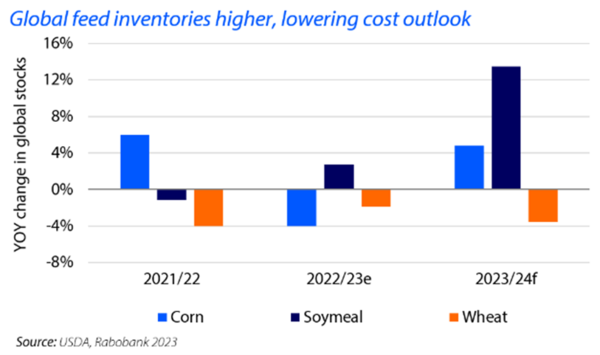
Source: Rabobank news release After productivity challenges in 2022 and 2023, several key growing regions appear to be turning a corner. While disease pressure is still an issue in some regions, overall herd health has improved. "A renewed focus on cost reduction - given inflationary pressures resulting in the elimination of less productive operations - is also contributing to a rebound in production per sow," says Christine McCracken, Senior Analyst - Animal Protein at Rabobank. "Although this improvement is a welcome trend and lowers costs, the additional production is compounding regional oversupplies and weighing on the market." At the same time, breeding herd reductions in most geographies outside Europe and South Korea are slow, despite ongoing margin pressure and limited optimism for a quick turnaround in global trade. Feed prices improve, though uncertainties remain Corn and soybean prices moved lower in the third quarter of 2023, after a good North American harvest helped rebuild stocks and expectations for a large South American crop emerged. While better, oilseed inventories remain below pre-Covid levels and leave little margin for error. Feed costs are now down 20% to 30% year-on-year in most geographies. While costs vary regionally, corn costs are down more sharply than soymeal and feed wheat. "With the emergence of an El Niño pattern, the focus will shift to potential impacts on the South American growing season," adds McCracken. "And while grain and meal prices are expected to remain lower, other rising costs - including labor, insurance, and financing - remain high for most producers." Slower consumption growth as consumers seek value Consumers are adjusting to inflationary pressures, yet pork remains a dietary staple and overall consumption trends remain stable. However, pack types and sales channels continue to shift. "With consumers still cautious, particularly in light of rising geopolitical uncertainty, we expect an ongoing focus on reducing spending," says McCracken. "Pork consumption should benefit from the high cost of competing proteins and more consumers cooking at home." Recent geopolitical events add further uncertainty to energy and financial markets and could influence consumers through the end of 2023 and in early 2024, even as the underlying economic environment continues to recover. Rabobank expects steady consumption in 2024 on lower pork prices and the benefit of high-cost competing proteins. Global trade slows as importers take cautious approach Pork trade slowed in July and August versus year-ago levels, as costly EU pork exports and relatively high frozen pork inventories in many key importing countries weighed on demand. Global pork importers remain cautious given disappointing holiday demand, currency volatility, and rising geopolitical risk. McCracken: "In the final quarter of 2023, we expect global trade to remain slow given large inventories, relatively high domestic production, and low pork prices in key importing regions. Rising EU pork prices may also limit export volumes." Tweet |
|
|
|
|
|
|
|
|
|||||||||||||