|
 |
|
|
|||


|
 |
|

Dec. 27, 2023
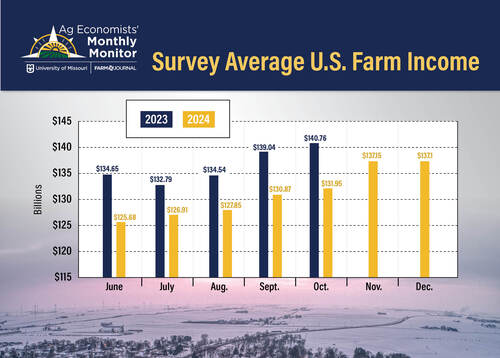
by Tyne Morgan, Farm Journal From the election to world trade, as well as geopolitical factors that have the potential to shape agriculture in 2024, ag economists think the coming year is poised for several possible surprises that could have a direct impact on farmers across the U.S. The December Ag Economists' Monthly Monitor, a survey conducted by University of Missouri and Farm Journal, shows economists' views on the ag economy are slightly more positive compared with the past month. While expectations about 2024 net farm income remained steady, ag economists' outlook for the year ahead grew slightly more pessimistic. Expect the Unexpected Looking ahead at 2024, economists in the December Ag Economists' Monthly Monitor were asked, "What unexpected news headline would you not be surprised to read in 2024?" Ag economists said: *China falls into big recession. *A second extension of the farm bill. *Corn prices test $4 again. *Inflation supports managed money returning to the commodities again. *World ends, poor hurt worst. *Record beef imports in 2023. *National corn yield >190 bpa; U.S. embargoes ag exports to China. *End to Russia/Ukraine war bumps global food grain supplies and cuts prices. *2024 planted acres across all crops similar to 2023. *Economic woes unfold for U.S. agriculture as input costs remain high and farm prices falter. Optimism for 2024 There is also optimism for the year ahead, which is sprouting from the possibility for continued improvement in drought as well as new areas of demand. Ag economists were asked what they're most optimistic about when it comes to the ag economy, and economists surveyed said: *Demand opportunities through domestic soybean crushing, renewable fuel, SAF and global oilseed. *Robust domestic consumption and opportunity for competitive pricing of U.S. commodities in global markets. *Improved farm-level conditions related to efficiency, moisture conditions and farm income above historical averages (if a recession is avoided and input costs come down); many ag producers still have a strong balance sheet. To read the entire report click here. Tweet |
|
|
|
|
|
|
|
|
|||||||||||||