|
 |
|
|
|||


|
 |
|

Apr. 10, 2026 by Ken Foster, Professor of Agricultural Economics and Director, Purdue Farm Policy Study Group; Bernhard Dalheimer, Assistant Professor of Macroeconomics and Tradeusly, Purdue University West Lafayette, IN -- Key Takeaways: -The Strait of Hormuz closure has driven crude oil above $110/barrel and nitrogen fertilizer prices up more than 30% -- a severe shock arriving at the worst possible time for spring planting. -However, farmers are not passive. Adjustments in fertilizer application rates and crop mix will moderate yield losses while simultaneotightening grain supplies and supporting output prices. -Farmers who pre-purchased or contracted fertilizer before the conflict are largely protected for the 2026 growing season -- cost exposure is heavily determined by purchasing timing. -Historical precedent (notably 2022) shows that sustained energy-driven cost shocks often produce enough commodity price response to preserve, and sometimes improve, net farm income. -Duration is everything: a short conflict resolved in weeks is likely a manageable cost squeeze; a prolonged Strait closure would eventually push grain prices high enough to partially offset margins. The Shock: Energy and Fertilizer Costs Under Pressure The conflict that began on February 28, 2026, with U.S.-Israeli airstrikes on Iran triggered the closure of the Strait of Hormuz -- the narrow chokepoint through which approximately 20 percent of the world's traded oil and significant volumes of liquefied natural gas (LNG) flow. Within days, Brent crude oil surged from roughly $70 per barrel to over $110, the highest level since Russia's 2022 invasion of Ukraine. Gasoline prices at the pump rose roughly 17 percent in the first two weeks of the conflict, and diesel -- the lifeblood of farming operations -- followed closely. For farmers, the more consequential channel may not be diesel fuel but nitrogen fertilizer. Natural gas is the primary feedstock (roughly 70-80 percent of production cost) for urea and anhydrous ammonia via the Haber-Bosch manufacturing process. The Gulf region is a major global supplier of nitrogen fertilizers, ammonia, sulfur, and phosphate; ship owners and insurers have been unwilling to transit the Strait, cutting off those shipments. The result: nitrogen fertilizer prices at the Port of New Orleans jumped from approximately $516 per metric ton before the conflict to $683 per metric ton within a week -- a 32 percent increase -- with analysts warning prices could go higher if shipments cannot reach U.S. ports before the spring planting window closes. As StoneX analyst Josh Linville observed: "Literally, this could not happen at a worse time of the year." Fertilizer is typically 20-30 percent of total corn production costs -- far larger than diesel's roughly 5-10 percent share -- making the fertilizer channel the primary financial concern. However, for the time being, there does not appear to be widespread risk of a fertilizer shortage for the current years' crop in the U.S. Figure 1
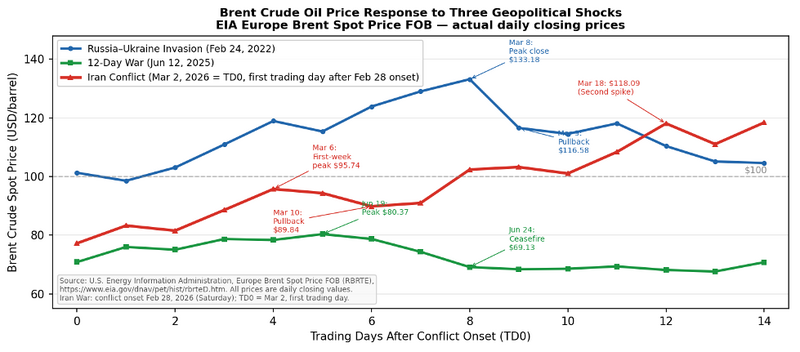
Brent Crude Oil Price Response to Three Geopolitical Shocks EIA Europe Brent Spot Price FOB - actual daily closing prices Comparative crude oil price trajectories following major geopolitical shocks, measured in trading days from conflict onset. All three series plot actual daily Brent closing prices from the EIA Europe Brent Spot Price FOB series. The Iran Conflict series runs through TD14 (March 20, 2026) and reveals a W-shaped double-spike pattern: a first-week surge peaking at $95.74/barrel on TD4 (March 6), a partial pullback to $89.84 by TD6 as early hopes for resolution circulated, and a second escalation to $118.09 on TD12 (March 18) and $118.42 on TD14 (March 20) driven by Iran's strikes on Qatar's LNG infrastructure and Iraq's declaration of force majeure. The 12-Day War of June 2025 illustrates a sharply contrasting trajectory: a modest spike peaking at $80.37 by TD5, with rapid reversion following the ceasefire -- prices had nearly fully retraced to pre-conflict levels by TD8. The Russia-Ukraine invasion produced the largest and most sustained shock within this window, reaching a closing high of $133.18 on TD8 (March 8, 2022), though that episode combined the energy-cost channel with direct disruption of Ukrainian grain exports -- a supply-side amplifier absent from the current conflict. Source: U.S. Energy Information Administration, Europe Brent Spot Price FOB (RBRTE), https://www.eia.gov/dnav/pet/hist/rbrteD.htm. All values are daily closing prices. Prices as of March 23, 2026; situation remains fluid Figure 2
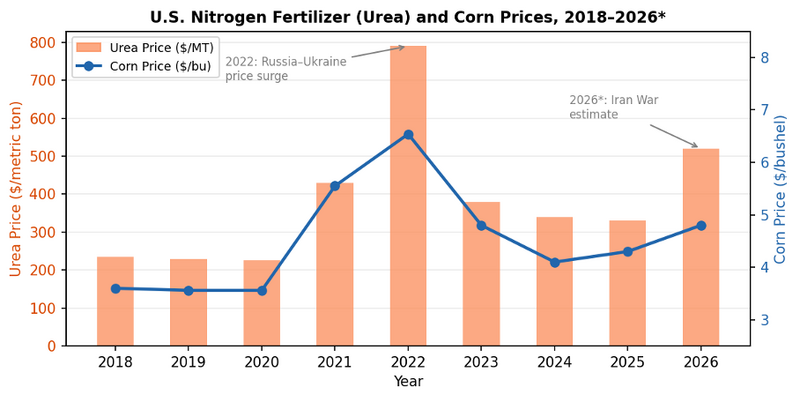
U.S. Nitrogen Fertilizer (Urea) and Corn Prices, 2018-2026 U.S. nitrogen fertilizer (urea) and corn prices, 2018-2026. The 2022 episode demonstrates how energy-driven fertilizer cost spikes can coincide with -- and be partially offset by -- higher output prices. The 2026 values reflect early post-conflict estimates; the corn price response is still developing. *2026 values are preliminary estimates. The 2026 urea estimate reflects approximately a 30% increase over pre-conflict prices, consistent with observed NOLA spot price moves in the first week of the conflict; the corn price is anchored to December 2026 new-crop futures as of early March 2026. How Farmers Will Adapt: Two Key Responses A simple first-order analysis that holds everything else constant -- "fertilizer is more expensive, therefore farm income falls" -- misses the dynamic responses that farmers make routinely in the face of shifting input-output price ratios. Two responses are especially important and, critically, both partially support output prices at the same time they reduce costs. To read the entire report click here. Tweet |
|
|
|
|
|
|
|
|
|||||||||||||