|
| CLICK HERE TO VIEW CURRENT ISSUE |
 |
| Best of NAMA 2026 |


|
 |
|
FARM BUREAU: RELAXING BEEF IMPORT QUOTAS SENDS MIXED SIGNALS TO RANCHERS
May 14, 2026
By Daniel Munch, Economist, American Farm Bureau Federation
Key Takeaways
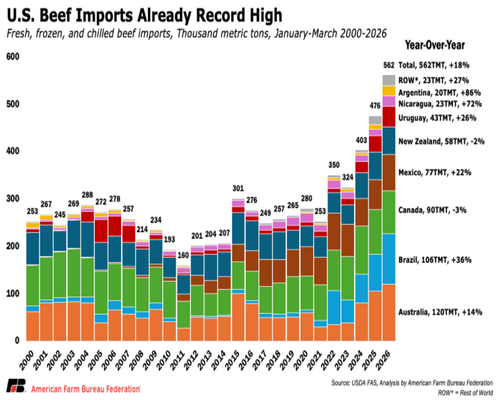
U.S. beef imports are already running at historically elevated levels. During the first quarter of 2026, the U.S. imported 562,000 metric tons of beef and beef products valued at nearly $4.5 billion, up 18% from last year and 122% higher than five years ago.
Existing import volumes are already higher than the implied quarterly pace of several annual beef tariff-rate quotas (TRQs). Suspending quantitative TRQ limits for 200 days would significantly reduce the tariff burden on additional imported beef entering the U.S. market.
Persistent drought and weak snowpack continue to constrain herd rebuilding. More than 79% of the beef cow herd across the 26 largest cattle-producing states is currently affected by drought conditions, increasing feed, forage and water costs.
Expanding import access during a period of herd contraction discourages U.S. cattle producers from making a long-term investment in rebuilding domestic cattle supplies.
The United States cattle industry is navigating one of the tightest supply environments in decades. The domestic cattle herd remains near multi-decade lows following years of drought, elevated feed and operating costs, herd liquidation and ongoing disruptions tied to New World screwworm restrictions along the southern border. At the same time, beef imports have already hit records. During the first quarter of 2026, the U.S. imported 562,000 metric tons of beef and beef products valued at nearly $4.5 billion, up 18% from the same period last year and 122% higher than five years ago.
Against that backdrop, the administration is reportedly considering a 200-day suspension of quantitative limits under the U.S. beef tariff-rate quota system, temporarily allowing eligible trading partners to ship unlimited volumes of beef into the U.S. market at lower in-quota tariff rates. While such a policy may modestly supplement short-term imported beef availability, it does not address the underlying factors constraining U.S. cattle production. More importantly, encouraging additional imports risks weakening incentives for ranchers to retain heifers and rebuild domestic cattle inventories over the long run.
Read More.
|
|
|
|
|