|
 |
|
|
|||


|
 |
|

Jul. 17, 2026
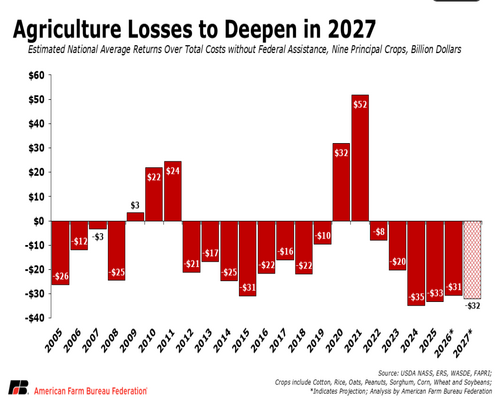
By Faith Parum, Ph.D. and Daniel Munch, American Farm Bureau Federation Washington, DC - Key Takeaways Global instability is pushing production costs higher. Fertilizer and fuel costs were already elevated heading into 2026, and the conflict with Iran has added further pressure to those markets. AFBF analysis shows losses are expected to deepen in 2027. AFBF estimates that without federal assistance, farmers growing nine principal crops will lose $32 billion (national average returns over total costs) in 2027, compared to $31 billion in 2026. On a per-acre basis, every crop analyzed is projected to remain below breakeven in 2027. Fruit, vegetable, nut and other specialty crop losses remain largely uncovered. AFBF estimates farmers growing six representative crops faced more than $7 billion in 2025 losses. The ASCF program provides welcome relief, but payment rates cover only about 5% to 28% of estimated 2025 per-acre losses for the crops analyzed. Available 2026 data show difficult market conditions continue, including below-breakeven prices, acreage reductions and weak margins across major specialty crop sectors. Additional economic assistance is needed and is supported on a bipartisan basis. Additional financial support is critical to offset trade-related losses, rising input costs and the deep financial pressure facing U.S. row crop, specialty crop, hay and sugar producers. This support would help stabilize the farm economy, sustain rural communities and maintain a strong domestic food supply. Longer term, policy solutions to help stabilize the farm economy are needed. Such as year-round E15; a modernized five-year farm bill that protects interstate commerce from a patchwork of state legislation; a legislative fix to agricultural labor; and stronger risk management tools, including better data collection and publication to support more effective options for specialty crop producers. Crop farmers continue to face elevated production costs, lower commodity prices and tight margins - with no relief on the horizon. AFBF analysis projects 2027 will mark a sixth year of negative returns over total costs for most major row crops. Specialty crop farmers are experiencing similar financial strain, facing expected below-breakeven prices and acreage reductions across major fruit, vegetable and tree nut sectors in 2026, even as limited public data make the full scale of losses difficult to measure. At the same time, fertilizer and fuel prices remain volatile, with the Iran conflict adding additional pressure to those markets. Row Crops USDA's June 30 Acreage report provides an updated acreage baseline for estimating the scale of economic losses across major row crops. Total U.S. principal crop acres are estimated to be down 1.91 million acres from 2025, a 0.6% decline overall. Corn planted area is estimated at 95.3 million acres, down 3% from last year but still the fourth-highest planted corn acreage in the U.S. since 1944. Soybean planted acreage is estimated at 85.4 million acres, up 5% from 2025, while all wheat planted area is estimated at 42.7 million acres, down 6% from last year. Using USDA-Economic Research Service cost of production data, World Agricultural Supply and Demand Estimates data, USDA-National Agricultural Statistics Service acreage data and Food and Agricultural Policy Research Institute projections, AFBF estimates national average returns over total costs, without federal assistance, at a $32 billion loss across nine principal crops in 2027, deepening from a $31 billion loss in 2026. These 2026 and 2027 figures represent projected, not realized, losses. Producers still have time to adjust acreage and input decisions, while weather, yields, market prices and other factors could change the final outcome. The 2027 estimate assumes crop prices remain at 2026 levels, though actual prices will vary in response to changing market conditions. Read More. Tweet |
|
|
|
|
|
|
|
|
|||||||||||||