|
 |
|
|
|||


|
 |
|

Oct. 2, 2026
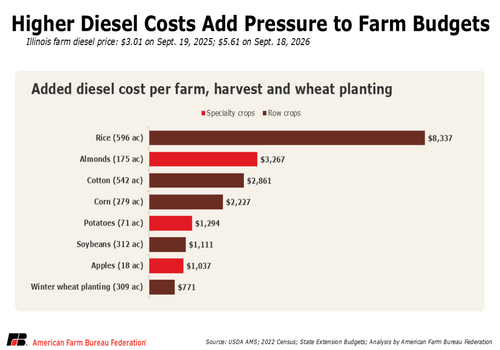
By Faith Parum, Ph.D. and Cameron Castillo , Economists, American Farm Bureau Federation Key Takeaways: America's farmers and ranchers rely heavily upon diesel to plant, grow and harvest their crops, and to get them to market. Ongoing geopolitical conflicts have created supply chain bottlenecks, which have led to record-high diesel prices in recent weeks. Most farmers and ranchers use off-highway diesel, also known as red-dye diesel or farm diesel. This type of diesel fuel is exempt from state and federal highway taxes. Several states have recently taken steps to help farmers and ranchers suffering from the burden of high diesel prices by allowing for the temporary use of farm diesel on public roadways. Diesel is used throughout agricultural production, powering tractors, combines, irrigation equipment and the trucks that move crops, livestock and farm inputs. With diesel prices rising sharply in recent weeks, fuel costs have become an even larger concern during one of the most fuel-intensive periods of the year. A recent Farm Bureau analysis detailed the global supply disruptions and tight fuel markets behind the increase in diesel prices. For farmers, the effects show up directly in the cost of operating equipment and indirectly through higher transportation costs. To illustrate the direct farm-level impact, Farm Bureau modeled fuel costs across several representative row crop and specialty crop farms. For each crop, the model combines average acres per farm from the 2022 Census of Agriculture with crop-specific diesel-use estimates drawn from university Extension budgets and production studies. That estimated seasonal fuel use is then multiplied by the change in the U.S. farm diesel price, which increased from $3.01 per gallon in September 2025 to $5.61 per gallon in September 2026, a gain of $2.60 per gallon. This analysis uses the Illinois farm diesel price reported by USDA AMS. Regional differences in fuel prices may result in higher costs for producers in other parts of the country. The results show how a diesel fuel price increase can impact farmers differently during harvest. Per our analysis, the average corn farm covers 279 acres and uses an estimated 3.07 gallons of diesel per acre (for all harvest-related activities), resulting in 857 gallons of diesel used over the fall harvest period. At the $2.60-per-gallon price increase, that adds roughly $2,227 to the farm's diesel bill. Read More Tweet |
|
|
|
|
|
|
|
|
|||||||||||||