|
 |
|
|
|||


|
 |
|

Oct. 5, 2026
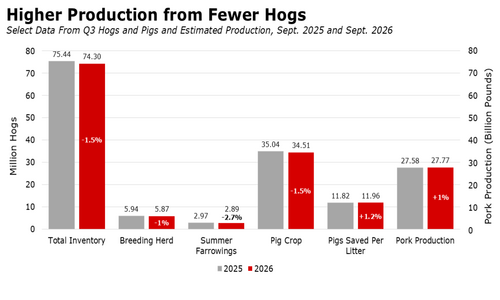
By Bernt Nelson, Economist, American Farm Bureau Fedeartion Key Takeaways USDA's September Hogs and Pigs report confirmed a smaller U.S. hog herd with total inventories near 74.3 million head, about 2% below a year ago, while the breeding herd remains historically tight. Hog farmers continue to resist major expansion but have not entered widespread liquidation. Farrowing intentions point to little growth potential through early 2027. USDA lowered pork export expectations for both 2026 and 2027, citing softer global demand and increasing competition from Canada and Brazil, particularly in Mexico, the largest foreign market for U.S. pork. Hog farmprofitability remains positive but vulnerable. Rising feed costs, driven by higher corn prices, are narrowing margins and could trigger herd liquidation if hog prices continue to weaken. The U.S. hog market is sending mixed signals for the remainder of 2026. Hog supplies continue to tighten as farmers resist expansion. Yet lower futures prices are signaling concerns that pork demand may be weakening faster than supplies are shrinking. USDA's September Hogs and Pigs report reinforced this reality. The total inventory of hogs and pigs on Sept. 1 was 74.3 million head, about 2% below last year, but up about 1.6% from revised estimates for last quarter's report. 2026 inventory numbers were down in every market weight category. Breeding inventories remained tight, pig crops were smaller and farrowing intentions point toward slight growth in 2027. Tight Breeding Herd, But no Evidence of Broad Liquidation The breeding herd was estimated to be 5.87 million head, down 62,000 head, or 1%, from last year and is the smallest since 2013. The June-August pig crop was estimated at 34.5 million head, down about 1.5% from a year ago. This was the result of fewer farrowings during the same time, estimated to be about 2.89 million, down 2.7% from a year ago. Pigs saved per litter were 11.96 --slightly more than 1% above 11.82 a year ago, partially offsetting the lower farrowings. None of this data suggests expansion in the hog sector, but it also doesn't suggest major liquidation that is typically tied to a decline in supply. Recent production trends help explain why ample supplies remain available even with a smaller herd. According to USDA's September Livestock, Dairy and Poultry Outlook, August federally inspected hog slaughter totaled approximately 9.9 million head, down 2.1% from a year earlier. Yet pork production declined by less than 1%. This was largely due to average dressed weights that were 212 pounds per head, about 3 pounds heavier than August 2025. These factors led USDA to estimate 2026 pork production at 27.77 billion pounds, nearly 1% above 2025 levels. Read More Tweet |
|
|
|
|
|
|
|
|
|||||||||||||