|
 |
|
|
|||


|
 |
|

Oct. 9, 2026
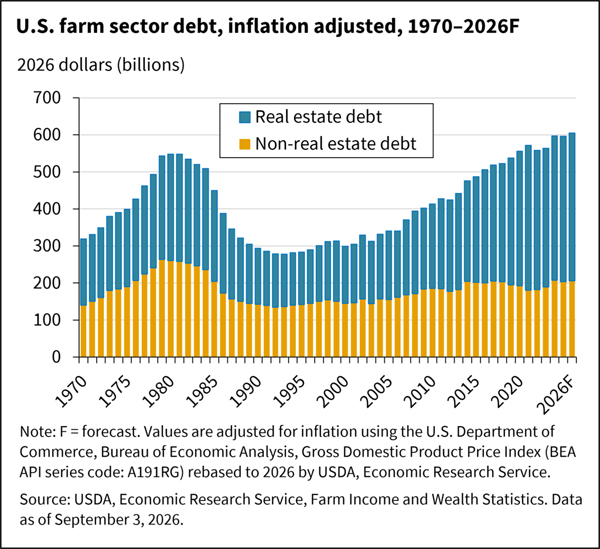
by Ryan Hanrahan, University of Illinois' FarmDoc project Urbana, IL - United States farm sector debt is expected to reach a record high $605.1 billion in 2026, according to the latest USDA forecast, a 4.5% nominal increase from 2025 and a 1.5% increase when adjusted for inflation. "Farm real estate debt is expected to reach $399.0 billion in 2026, a 4.6-percent increase in nominal dollars (a 1.6-percent increase in inflation-adjusted dollars)," USDA's Farm Income Team wrote. "Farm non-real estate debt is expected to reach $206.1 billion in 2026, a 4.4-percent increase in nominal terms (a 1.4-percent increase in inflation-adjusted dollars)." "Farm sector solvency is forecast to worsen in 2026 relative to 2025, with debt forecast to grow at a faster rate than assets or equity. Solvency measures the ability of a farm or ranch operation to satisfy its debt obligations when due," USDA's Farm Income Team wrote. "Popular measures of solvency include the debt-to-asset ratio and debt-to-equity ratio. Lower values for these ratios are preferred. Debt-to-asset levels are forecast to increase slightly from 13.34 percent in 2025 to 13.54 percent in 2026." "Liquidity is the ability to transform or convert assets to cash quickly to satisfy short-term obligations when due without a material loss of value or price of the asset. One key measure of liquidity is working capital, which measures the amount of cash available to fund operating expenses after paying off debt to creditors due within 12 months (current debt)," USDA's Farm Income Team wrote. "It is forecast to increase 3.5 percent nominally in 2026 after declining 15.0 percent in 2025. However other measures, such as the debt service ratio, show liquidity worsening in 2026." USDA Debt Number May be an Undercount Reuters' P.J. Huffstutter reported that "American farmers are borrowing more money than ever before to operate -- but the rise in non-traditional and vendor credit has created some gaps in the federal government's current ability to measure and track farm debt, US Department of Agriculture officials told Reuters." "Farmers are increasingly borrowing from suppliers, farmer cooperatives, equipment manufacturers, financial technology firms and other nontraditional lenders that are more difficult for the government to comprehensively measure," Huffstutter reported. "The USDA is launching research projects to better track that debt, and to understand whether financial stress in agriculture could be affecting the broader economy, officials said." "'There are new lenders popping up and we need to find ways to access that data,' Jeffrey Hopkins, acting assistant administrator at USDA's Economic Research Service, told Reuters," according to Huffstutter's reporting. Ag Profitability Also Weighing on Farm Economy AgroLatam's Marco Díaz Collins reported that "the financial outlook becomes more challenging when rising debt is compared with agricultural profitability." "USDA projections indicate that farm production expenses will reach $492.8 billion in 2026, an increase of 4.5% from the previous year. Meanwhile, net farm income is expected to decline to $158.4 billion, representing a 2.6% nominal decrease and a 5.5% reduction after inflation," Díaz Collins reported. "For farmers, these trends mean that financing decisions must increasingly account for elevated fertilizer, fuel, labor, land and equipment expenses alongside uncertainty in commodity markets." Tweet |
|
|
|
|
|
|
|
|
|||||||||||||