|
 |
|
|
|||


|
 |
|

Oct. 12, 2026
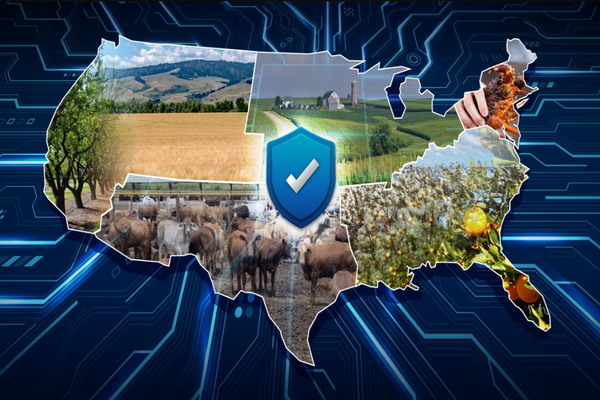
Source: Iowa State University news release Ames, IA - The enormous depth and breadth of America's agrifood system that provides such ample and diverse bounty also puts it at high risk for cyber attack. The best way to secure our critical agricultural and food production complex is by creating a national, geographically distributed Agriculture Cybersecurity Consortium (ACC) based on strong partnerships, including farms, cooperatives, agribusiness, cybersecurity businesses, government, NGOs, and academia. This is the overarching recommendation outlined in the article "Cybersecurity and Resiliency in Agricultural and Food Systems" published October 1 in the scientific journal, Nature Food. The article reflects a consensus perspective derived from three regionally coordinated workshops and follow-up sessions involving more than 150 stakeholders and participants. The effort was led by Iowa State University collaborating with the University of California-Davis, Washington State University, Virginia Tech, North Carolina A&T State University, and the International Center for Food Ontology Operability Data and Semantics (IC-FOODS), a non-profit research institute dedicated to designing internet of food cyberinfrastructure. The lead investigators from Iowa State University are: Manimaran Govindarasu, Anson Marston Distinguished Professor in Engineering and Murray J. and Ruth M. Harpole Professor in Electrical and Computer Engineering; and Doug Jacobson, Sunil & Sujata Gaitonde Professorship in Cybersecurity and director of the Iowa State Center for Cybersecurity Innovation and Outreach. The workshops were supported in part from funding Govindarasu and Jacobson received through Iowa State's Presidential Interdisciplinary Research Initiative. PIRI funds are intended to support interdisciplinary research groups that come together to address overarching issues with significant state-level, national, and/or global implications. Support for IC-FOODS came from National Science Foundation (NSF) funding for the AI Institute for Intelligent Cyberinfrastructure with Computational Learning in the Environment (ICICLE). The vision Govindarasu, Jacobson, and their multidisciplinary Iowa State team created for their PIRI project - Cybersecurity for Smart Agriculture - was the foundation for the ACC outlined in the Nature Food article. "There are many factors that make America's agrifood system particularly vulnerable to cyberattack, from farm to agribusiness to supply chain," Govindarasu said. "The vision that Iowa State, our partner institutions, and stakeholders have created for the Agriculture Cybersecurtiy Consortium will be a critical step in moving our agrifood system from it's current mode of reactive crisis management toward anticipatory, national-level resilience." The Nature Food article - overseen by Matthew Lange, CEO and Chief Science Officer of IC-FOODS, and Richard Hull, a principal scientist at IC-FOODS and computer science lecturer at UC Davis - indicates the ACC would focus on synergistic activities around three pillars: multidisciplinary research and development; research infrastructures and testbeds; and educational programs and workforce development. "We learned during the COVID-19 pandemic that when large meat processors go offline, disruptions cascade rapidly through the food supply chain," Lange said. "Cyberattacks produce remarkably similar consequences. The 2021 ransomware attack on JBS shut down major meat-processing operations across multiple countries. Cybersecurity is not simply an IT problem - it is a food-system resilience problem. The Agriculture Cybersecurity Consortium gives us a way to build the collective capacity needed to confront that systemic risk." Multidisciplinary Research and Development The ACC would support ongoing research across disciplines to strengthen cybersecurity in food and agriculture. Key priorities could include: Using AI and other emerging technologies to detect, prevent, and respond to cyberattacks; Creating simpler, more efficient ways to verify users and devices; Finding security flaws and building safeguards into equipment and software; Developing realistic farm testing environments to assess risks and understand attackers' capabilities; Exploring shared digital records that make unauthorized changes easier to detect; and Sharing cybersecurity best practices and identifying investments that reduce risk. Land-grant and other research universities would conduct much of this work with support from federal and state government agencies, alongside additional industry research. Research Infrastructures and Testbeds The ACC could bring university researchers, industry experts, and other partners together to test cybersecurity solutions using real-world agricultural equipment and environments. Expanding these facilities would support research, hands-on training for students and professionals, public demonstrations, and evidence-based policies and standards. Land-grant universities, U.S. Department of Agriculture (USDA) Agricultural Research Service (ARS) facilities, regional irrigation districts, and industry groups could develop and operate these sites with government support and possibly industry partnerships. Education and Workforce Development The ACC would provide the foundation for cybersecurity as an everyday practice in food and agriculture through education and training for students, working professionals, and outside service providers. Extension educators could deliver practical, farm-focused instruction on protecting equipment and networks. Hands-on exercises could help participants practice responding to cyberattacks while keeping operations running. The ACC would share training materials and threat information across regions, building on existing university partnerships with industry and government. These efforts would require federal-level funding support. "Every day, millions of small- and medium-sized agrifood operations across the supply chain face very real cyber risks, though many may not realize how vulnerable they are," Hull said. "With the advent of agentic AI, cyber attacks are growing in number and sophistication. "Our hope with this paper is to accelerate a shift toward making cyberhealth a fundamental part of agrifood operations, alongside crop health, animal health and food safety," Hull added. "Through the Extension networks of land-grant universities, the Agriculture Cybersecurity Consortium can drive this shift by turning cybersecurity research into practical guidance and capabilities that smaller operations - the backbone of so much of our food system - can understand, trust and put to work." The consensus of workshop participants was the ACC should be structured to connect five regional centers - Midwest, Northwest, Northeast, Southwest, and Southeast - through a national coordinating hub. Each center would work with local partners to conduct cybersecurity research, develop testing facilities, and provide education and workforce training tailored to regional needs. One center could also serve as the national coordinator. This structure builds on models used successfully by the National Plant Diagnostic Network and USDA Climate Hubs. Stakeholders also concur that land-grant universities with strong cybersecurity and AI research programs are optimal candidates for the five regional centers. These institutions combine agricultural expertise, cybersecurity and AI research, and education programs that prepare tomorrow's workforce. Their Extension programs offer trusted local relationships and a deep understanding of regional needs, helping translate research into practical guidance for food and agriculture professionals. Together, these strengths make land-grant universities natural partners for developing and sharing cybersecurity solutions and training. Workshop participants and stakeholders acknowledge that creating and sustaining the Agriculture Cybersecurity Consortium will require significant federal- and state-level funding and the support of a robust public-private partnership. Jacobson asserts this is a sound long-term investment in the betterment of the agrifood industry and the nation as a whole. "Access to a secure, nutritious food supply is vital to national security, but true resilience requires embedding cybersecurity across every link of the agrifood supply chain," said Jacobson. "Whether it's a small family farm, a regional processor, or a global distributor, every operation must be equipped with the knowledge and tools to defend against cyber threats. By combining cutting-edge university research with direct extension outreach, the Agriculture Cybersecurity Consortium will make cybersecurity accessible and practical for all producers, thus ensuring digital innovation strengthens, rather than threatens, our agricultural foundation." In addition to Govindarasu and Jacobson, the other co-authors of the Nature Food article are: Feras A. Batarseh, Virginia Tech; Monowar Hasan, Washington State; Richard Hull, IC-FOODS and UC Davis; Matthew C. Lange, IC-FOODS; Lav R. Khot, Washington State; Karl Levitt, UC-Davis; Mohammad Sadoghi, UC-Davis; Matt Bishop, UC-Davis; Greg Goins, North Carolina A&T; Assefaw Gebremedhin, Washington State; Ananth Kalyanaraman, Washington State; Surya Mallapragada, Iowa State; Abdolhossein Sarrafzadeh, formerly of North Carolina A&T; Kang Xia, formerly of Virginia Tech; Jim Reecy, formerly of Iowa State. Tweet |
|
|
|
|
|
|
|
|
|||||||||||||