|
| CLICK HERE TO VIEW CURRENT ISSUE |
 |
| Best of NAMA 2026 |


|
 |
|
USDA: SOYBEAN OIL USE IN BIOFUELS SURGES ABOVE RECENT TREND
Oct. 30, 2026
Source: USDA news release
Soybean oil--produced by crushing soybeans and extracting the oil--is the dominant vegetable oil produced and consumed in the United States, making up half of total consumption of vegetable oils and rendered animal fats.
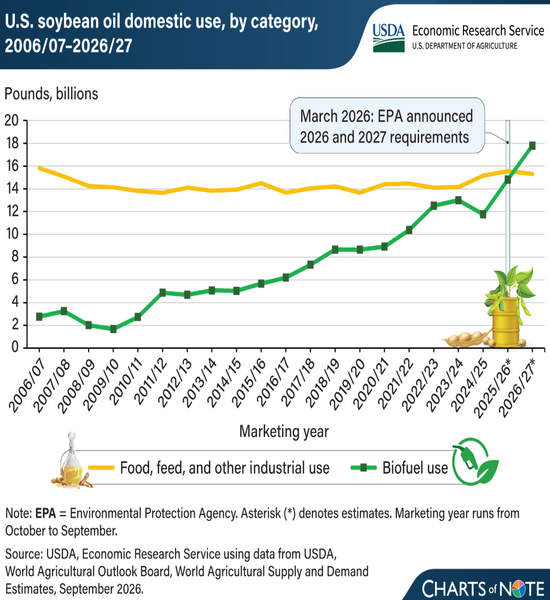
Traditionally, soybean oil has been used in food products such as salad and cooking oils, bakery shortening, and margarine, as well as in industrial applications. The use of soybean oil for food, feed, and other industrial applications has been fairly steady over the past two decades.
In contrast, the volume of soybean oil used as an input (referred to as a feedstock) in biofuel production has risen over the same time period before surging recently and surpassing its use in other applications. The demand for biofuels--a category including biodiesel, renewable diesel, and sustainable aviation fuel--is driven by Federal and State policies.
Biofuel production is set to further increase following the U.S. Environmental Protection Agency's release of record-high Renewable Volume Obligations for calendar years 2026 and 2027. This increase in biofuel demand is forecast to result in higher feedstock usage, especially for soybean oil.
Consequently, soybean oil consumption for biofuel production in marketing year 2026/27 is forecast to increase to 17.8 billion pounds and account for over 50 percent of total domestic soybean oil consumption.
This strong demand for soybean oil is forecast to push soybean oil prices to record highs in 2026/27, contributing to a record crush volume. The higher soybean crush volumes are achievable due to expansion in U.S. crush capacity between 2021 and 2026. With growth in soybean crush and exports expected in 2026/27, the U.S. soybean season-average farm price is forecast at its highest since 2023/24 at $12.00 per bushel.
|
|
|
|
|