|
 |
|
|
|||


|
 |
|

Nov. 2, 2026
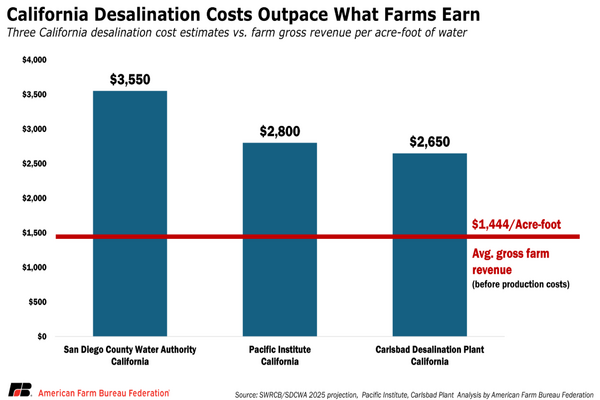
By Danny Munch, Economist, American Farm Bureau Federation Key Takeaways Desalination may help expand municipal and industrial supplies, but its cost, energy and infrastructure requirements make it unfeasible as a direct replacement for large-scale agricultural irrigation. Estimates for new seawater desalination in California reach $3,400 to $3,700 per acre-foot -- more than twice the roughly $1,444 in average gross farm revenue generated per acre-foot of applied water. Even at $3,000 per acre-foot, desalinated water would add roughly $6,900 to $11,250 per acre for representative lettuce, strawberry and almond operations already facing negative margins. Farm and household water are not the same product. City water must be treated to drinking-water standards and pumped through pressurized systems to homes and businesses, while irrigation water generally requires much less treatment and distribution infrastructure. The Colorado River is one of the most economically important water systems in the West, supporting communities, businesses and some of the nation's most productive agricultural regions. It also underpins food supply chains Americans depend on most heavily during the winter, when areas such as Yuma, Arizona, and California's Imperial Valley become major sources of fresh vegetables. At the same time, the basin faces a long-term imbalance between available water and existing demands, intensifying debate over conservation, infrastructure and potential new sources of supply. One option that regularly enters that discussion is ocean desalination. The appeal is easy to understand. Rather than reallocating an existing water supply among users, desalination can create new, drought-resistant freshwater from the ocean. It is already used in communities around the world and could supplement municipal or industrial supplies in parts of the Western U.S. For agriculture, however, the central question is not whether desalination works. It is whether the water it produces can be supplied at a price compatible with commercial food production. On that question, the economics are difficult to overcome. Desalinated Water Comes at a Very Different Price Most large ocean desalination plants use reverse osmosis, forcing seawater under high pressure through membranes that remove salts. The technology is well established, with roughly 16,000 to 17,000 desalination plants operating worldwide, but it has not experienced the dramatic cost declines seen in technologies such as solar and wind. For California, the most relevant estimates are measured in thousands of dollars per acre-foot. The California State Water Resources Control Board cites projected seawater desalination costs of $3,400 to $3,700 per acre-foot in 2025. The Pacific Institute estimated roughly $2,100 per acre-foot for large California projects and $2,800 for smaller facilities, while water from the Carlsbad Desalination Plant is estimated at roughly $2,500 to $2,800 per acre-foot when adjusted for electricity prices. Lower costs are often cited overseas. Israel's Sorek B facility has contracted water near $505 per acre-foot, while Dubai's Hassyan project reached roughly $450. Those projects show what desalination can achieve under favorable conditions, but differences in energy costs, scale, infrastructure, financing and regulation make them difficult to replicate in the American West. The economic mismatch becomes clearer when those costs are compared with what agricultural water produces. California agriculture generated about $1,444 in gross farm revenue per acre-foot of applied water in 2020. Agricultural output per unit of water has nearly doubled since 1967, while total applied water increased only 8%. Read More. Tweet |
|
|
|
|
|
|
|
|
|||||||||||||