 |
| CLICK HERE TO VIEW CURRENT ISSUE |
 |
| Best of NAMA 2026 |


|
 |
|
USDA: ACCESS TO WIC-AUTHORIZED VENDORS AND HIGH-SPEED INTERNET SERVICES VARIES ACROSS U.S.
Nov. 4, 2026
Source: USDA news release
The USDA Special Supplemental Nutrition Program for Women, Infants, and Children (WIC) provides access to healthy food for pregnant and post-partum women, infants, and children up to age 5. WIC provides participants with benefits to purchase nutrient-rich food, such as eggs, whole-grain bread, fruits, and vegetables, at a WIC-authorized vendor.
Recently, USDA began updating federal regulations to allow for online grocery shopping as an option for WIC food purchases, and some WIC State agencies have piloted WIC online shopping projects. WIC-eligible families may have limited access to a physical store that accepts WIC benefits but adequate access to high-speed internet services that could facilitate online shopping.
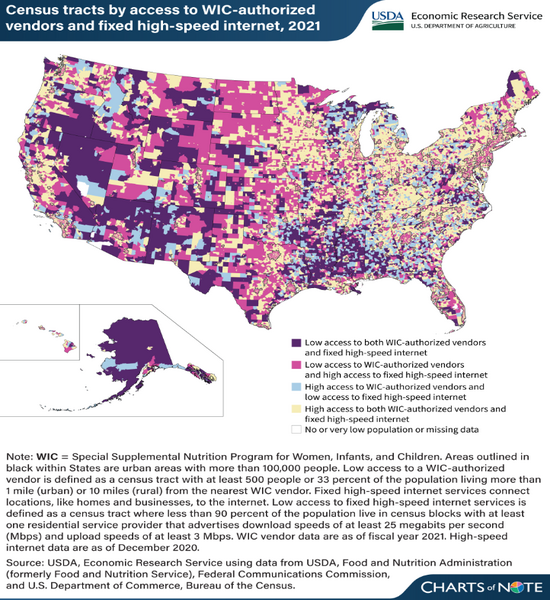
Internet access also facilitates use of other WIC services offered online, like nutrition education and eligibility certification. Access levels to WIC vendors and fixed-high speed internet services vary by census tract, a geographic proxy for neighborhoods. In 2021, 3 percent of all tracts (2,151 of 72,516 tracts) had low access to both. These tracts were concentrated in rural areas which tend to cover much larger land areas than urban tracts.
About 46 percent of tracts (33,520) had low access to a WIC vendor but adequate access to fixed high-speed internet services. These tracts were concentrated in urban areas, which typically cover much smaller land areas. Another 4 percent (2,595) had adequate access to a WIC vendor but low access to fixed high-speed internet services. These tracts were also geographically concentrated in rural areas. The remaining 47 percent of census tracts (34,250) had adequate access to both and were geographically concentrated in urban areas.
|
|
|
|
|