 |
| CLICK HERE TO VIEW CURRENT ISSUE |
 |
| Best of NAMA 2026 |


|
 |
|
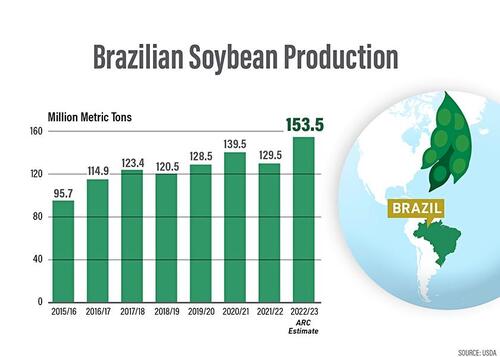
ECONOMIC FORECASTING SERVICE AGRESOURCE ESTIMATES BRAZIL'S SOYBEAN CROP UP 18% OVER PRIOR YEAR
Jan. 26, 2023
 |
|---|
| After a week in Mato Grosso, the AgResource team estimates a final yield estimate of 60.3 bu. per acre, which is 8 bu. more than CONAB’s current forecast. |
AgWeb.com reports:
The AgResource team has been on the ground in Mato Grosso, Brazil this past week. Here's a summary of their findings from the soybean rows.
A large Brazilian soybean crop will be harvested in the next 30 to 45 days, and most likely USDA, CONAB (the National Supply Company, a public company under the Ministry of Agriculture, Livestock and Food Supply in Brazil) and private analysts will be forced to raise Brazilian soybean production estimates by 1 million to 3 million tons (37 million to 110 million bushels). A crop of at least 150 million tons versus 129.5 million last year is guaranteed.
AgResource's final yield estimate in Mato Grosso, by far the country's largest producing state, is 60.3 bu. per acre after revisiting possible harvest losses and disease pressure. This is 8 bu. per acre more than CONAB's current forecast.
Their final stop of the tour in Cuibá, Mato Grosso, the state's capital, included a visit to an organization called IMEA, which monitors and collects data on all things agriculture in central and western Brazil. IMEA reiterated they, too, are finding yields above expectations.
There will be yield loss in the far south of Brazil, but yield gains in Mato Grosso and surrounding states will more than offset any yield hit.
Harvest losses will likely result from new incurable (for now) diseases. Local farmers suggest it will be a challenge for final yields to exceed 60 bu. But there is very little doubt a massive Brazilian soybean crop will be available to the global marketplace in the coming weeks. Dry weather in Mato Grosso over the next 5 to 7 days will allow harvest, statewide, to reach 6% to 8% complete this weekend. Additionally, safrinha corn planting will occur on a timely basis.
U.S. producers must acknowledge that Brazil will intensely compete for world market share in 2023. IMEA also shared data with AgResource that indicates the area dedicated to soybean production might double over the next decade. Studies show a large portion of Mato Grosso's current pastureland is conducive to soybean production. With expanded soybean area comes larger safrinha corn production. Price, costs and currency will determine just how quickly expansion occurs, but Brazil does have the ability to help meet larger global soybean, meal and oil consumption over the next decade.
To read the entire report click here.
|
|
|
|
|


